
CVE-2026-21643 is a critical SQL injection vulnerability affecting Fortinet FortiClientEMS 7.4.4. The vulnerability allows an unauthenticated attacker to execute unauthorized code or commands on the affected EMS server. It has a CVSS 3.1 score of 9.8 (Critical) and has been added to CISA’s Known Exploited Vulnerabilities catalog, which makes timely remediation particularly important for organizations running affected versions.
For security teams, the main concern is that the vulnerability can be exploited remotely without requiring valid FortiClient EMS credentials.
What is FortiClient EMS?
FortiClient Enterprise Management Server (EMS) is used to centrally manage FortiClient deployments. It provides administrators with capabilities for managing endpoints, policies, configurations and other aspects of an organization’s Fortinet endpoint security environment.
Because EMS acts as a centralized management platform, a compromise of the server can have a broader impact than compromising an individual endpoint.
What is the vulnerability?
CVE-2026-21643 is classified as a SQL injection vulnerability (CWE-89).
The issue occurs because attacker-controlled input is not properly handled before being used in SQL operations. Under the vulnerable configuration, an attacker can send a specially crafted HTTP request to the EMS server and manipulate the SQL query being processed by the application.
The important part from an attack perspective is that authentication is not required. An attacker who can reach the vulnerable service can therefore attempt exploitation without first obtaining an EMS account.
Why is it serious?
The combination of remote exploitation, no authentication requirement and potential command execution makes this vulnerability particularly serious.
FortiClient EMS is not simply a standalone application. It is a management platform used to administer security software across an organization’s endpoints. A successful compromise of the EMS server could therefore give an attacker access to a highly privileged position within the environment.
The actual impact will depend on the configuration and privileges of the affected server, but unauthorized command execution on a centralized management system can potentially lead to further compromise of the surrounding infrastructure.
How could the vulnerability be exploited?
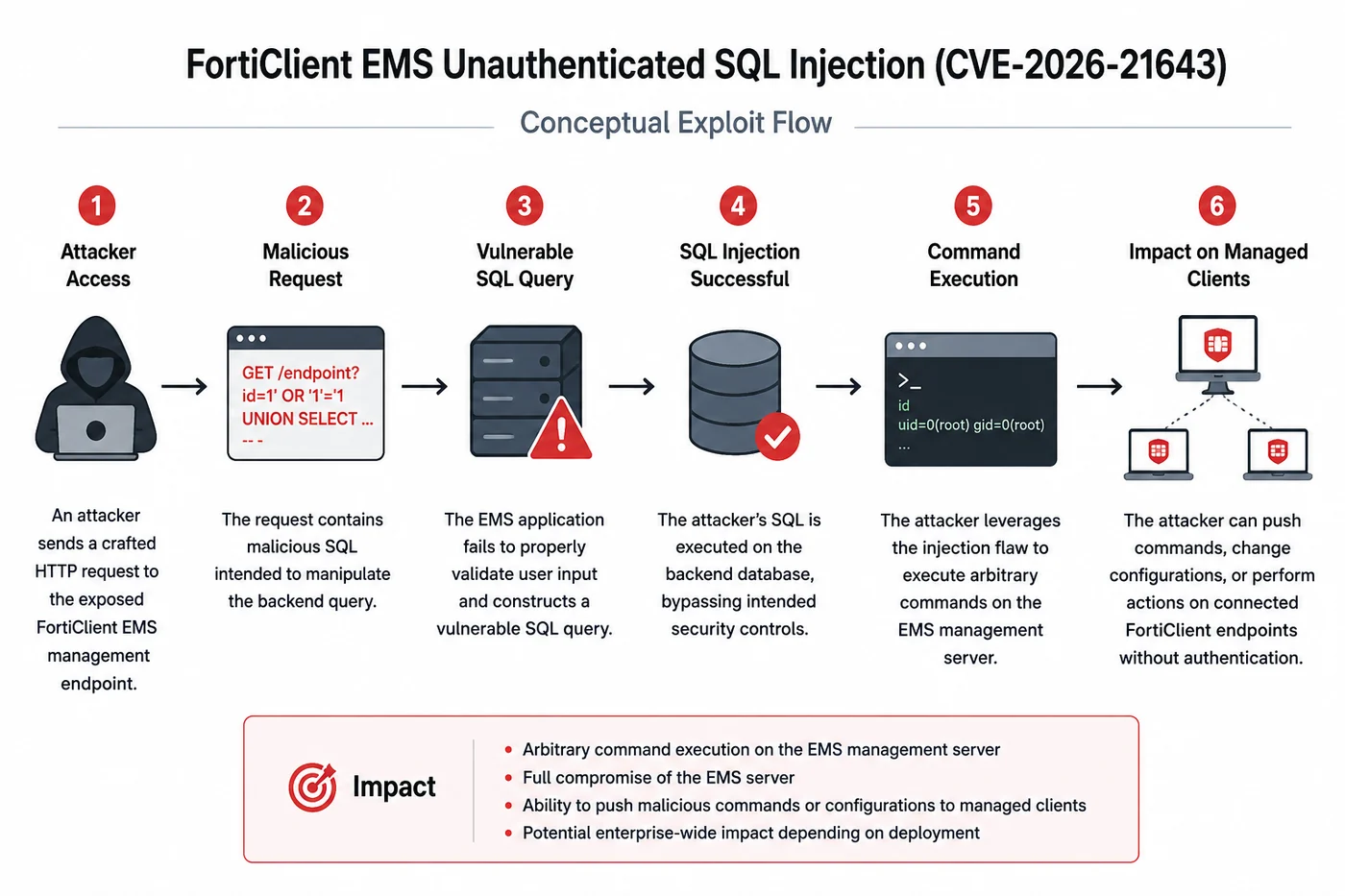
At a high level, exploitation involves sending a specially crafted HTTP request to the vulnerable FortiClient EMS service.
- 01Attacker reaches the exposed FortiClient EMS service
- 02A specially crafted HTTP request is sent
- 03Attacker-controlled data reaches a database operation without adequate protection
- 04The SQL query is manipulated
- 05Code or command execution on the EMS server
The attack does not require legitimate EMS credentials. For VAPT engagements, however, testing should only be performed against systems that are explicitly authorized and included within the assessment scope.
Affected versions
Fortinet identified FortiClientEMS 7.4.4 as affected by CVE-2026-21643. The vulnerability was addressed in FortiClientEMS 7.4.5. Organizations should verify the version currently deployed in their environment and follow Fortinet’s latest security advisory when planning the upgrade.
What should organizations do?
The primary recommendation is straightforward: upgrade affected FortiClient EMS installations to a fixed version.
Organizations should also identify whether any vulnerable EMS instances are exposed to untrusted networks. Management interfaces should not be unnecessarily exposed to the Internet, and access should be restricted to trusted administrative networks wherever possible.
Since the vulnerability has been exploited in the wild, organizations that operated an affected and exposed version should also consider investigating the system for signs of compromise. Security teams can review EMS and network logs for unusual requests, unexpected administrative activity, configuration changes, suspicious processes and other indicators that could suggest exploitation.
What VAPT teams should look for
CVE-2026-21643 is a good example of why vulnerability assessments should consider both the vulnerability and the role of the affected asset. When assessing an enterprise security management platform, testers should establish:
- Whether the management interface is externally accessible
- Which FortiClient EMS version is deployed
- Whether authentication is required before reaching the vulnerable functionality
- Whether the identified version is affected by a known vulnerability
- What level of access could potentially be obtained following exploitation
The assessment should then translate the technical finding into an impact that the client can understand and act upon.
Why management servers deserve particular attention
Security management platforms are often highly trusted within an organization’s infrastructure. They may have access to endpoint configurations, security policies and administrative functions that are not available to ordinary users. This makes them attractive targets for attackers.
A vulnerability in an endpoint management server can be more significant than its software classification alone suggests.
During a VAPT assessment, identifying these high-value management systems and prioritizing their exposure is an important part of understanding the organization’s actual attack surface.
Where Depth Defense fits in
At Depth Defense, vulnerabilities such as CVE-2026-21643 highlight the importance of assessing not only software versions but also how security management systems are exposed within an organization’s environment. Through VAPT and security assessments, Depth Defense can help organizations identify vulnerable systems, assess their exposure and potential impact, validate security weaknesses within an authorized scope, and provide practical remediation guidance to reduce the risk of compromise.